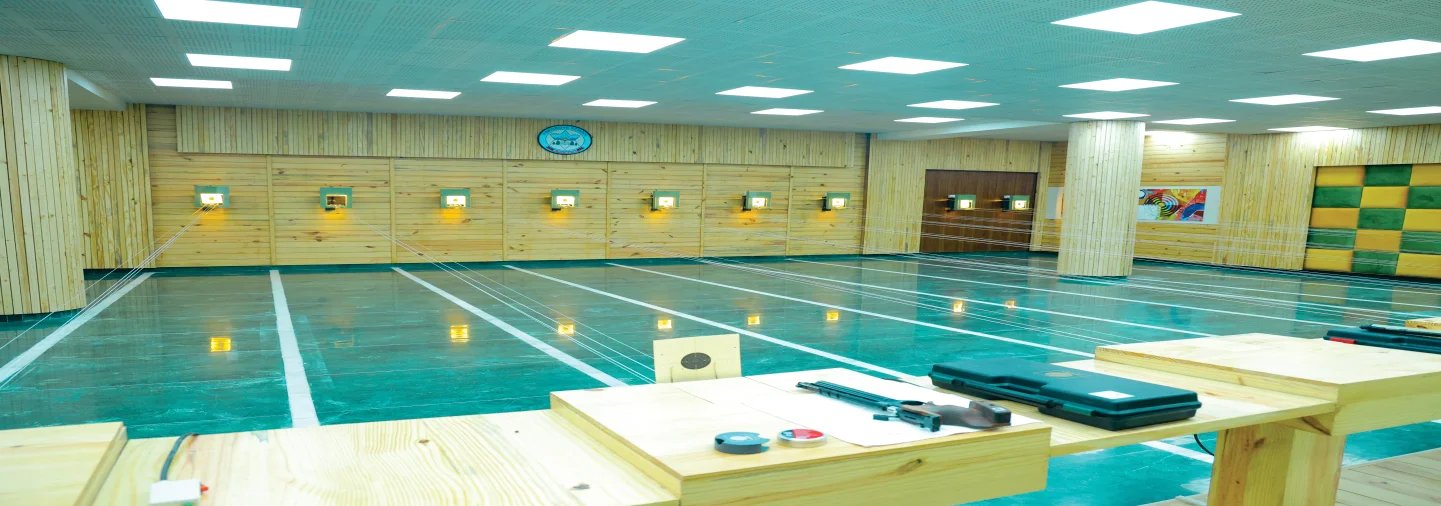
The acoustic behaviour of an indoor firing range changes dramatically when a short, high-energy sound event interacts with concrete, steel, glass and other reflective surfaces. The initial impulse is only part of the problem. Reflections can continue through the enclosure, communication can become more difficult, and sound energy can find paths into adjacent areas.
That makes soundproofing for shooting range environments different from ordinary commercial noise control.
The objective is not simply to put absorptive material on a wall. A properly considered acoustic strategy has to address internal reflections, reverberation, sound transmission, structural paths, communication requirements, ventilation and the durability of materials used in the environment.
Himalyan Acoustics' current shooting-range solution specifically identifies high-SPL impulse noise, prolonged reverberation, speech clarity, structure-borne vibration and noise leakage as acoustic challenges associated with enclosed shooting ranges.
Ordinary background noise tends to be relatively continuous. An indoor range introduces repeated impulse events with very short durations and substantial acoustic energy
Once an impulse enters an enclosed space, reflective surfaces can return portions of that energy toward the occupied area. Concrete walls, metal surfaces and glazing can create multiple reflection paths. The room can therefore continue sounding active after the original event has occurred.
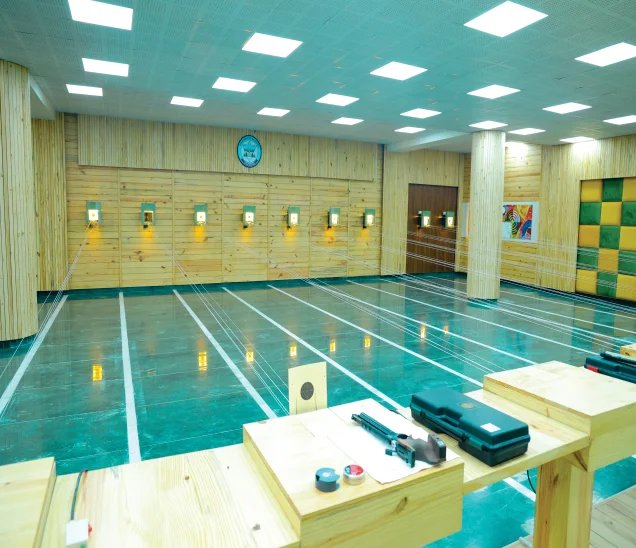
Wall and ceiling surfaces can require coordinated treatment based on reflection paths and room geometry.
This creates several interconnected design concerns:
The current Himalyan Acoustics shooting-range page describes the acoustic challenge in terms of impulse noise, reverberation, communication and isolation, while identifying specific treatment objectives for enclosed ranges. Those figures are project-specific claims from the company's current solution page rather than universal performance guarantees.
This distinction matters because a range may have adequate internal absorption but still transmit sound through its enclosure or building services.
Sound does not simply stop at the surface where it first arrives.
Within an enclosed range, energy can be reflected between walls, ceilings and other hard surfaces. Some of it is absorbed by the room's acoustic treatment, while some can continue travelling through the enclosure.
There are therefore two different questions to ask:
What happens to sound inside the range?and
What happens to sound that reaches the range boundary?The first question relates primarily to absorption and reverberation control. The second relates to isolation and sound transmission.
The difference is fundamental to acoustic treatment for shooting range projects. Internal treatment can make the acoustic environment more controlled, but it does not automatically prevent sound from travelling through walls, doors, ceilings, floors or service penetrations
Where structural vibration is involved, another pathway has to be considered. Himalyan Acoustics describes vibration isolation as a method of decoupling surfaces so mechanical vibration is less readily transferred through floors, walls and ceilings.
A well-designed range normally requires both concepts to be considered separately.
Acoustic TreatmentAcoustic treatment primarily manages the behaviour of sound inside the range.
It can address:
Absorptive wall and ceiling treatments are therefore part of the internal acoustic strategy.
Sound IsolationSound isolation focuses on reducing transmission between the range and other spaces.
Potential transmission routes include:
Himalyan Acoustics' acoustic principles page defines sound absorption as reducing resonance within a room and sound insulation as addressing sound transmission from one area to another. It also distinguishes NRC as an absorption measure and STC as a sound-blocking measure.
That distinction should remain clear throughout the design.
A highly absorptive wall surface may reduce reflected sound inside the range without providing the isolation required through the building envelope.
Reverberation becomes particularly important when repeated impulse events occur inside a reflective enclosure.
The issue is not simply whether the room sounds “loud.” Reflections can interfere with communication between range personnel and users, increase acoustic harshness and create a less controlled sound environment.
The current shooting-range project information identifies reverberation control, first-reflection management and speech clarity among its design objectives.
Wall Reflection ManagementWalls can become major reflection surfaces, particularly where the construction is dense and highly reflective.
A wall-treatment strategy should consider:
The current Himalyan Acoustics wall-absorption range includes modular, fabric and wood acoustic systems, as well as sound-blocking wall approaches. The page distinguishes absorption-oriented systems from sound-blocking systems rather than treating them as interchangeable.
This is where wall acoustic treatment needs to be selected according to the actual acoustic objective.
Ceiling Reflection Management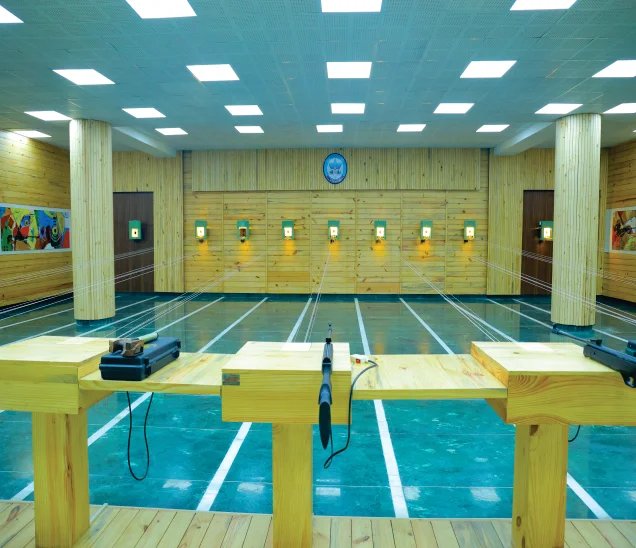
Wall and ceiling surfaces can require coordinated treatment based on reflection paths and room geometry.
The ceiling can create another large reflection surface.
In an enclosed range, ceiling height, construction, lighting, ventilation and service equipment can all influence how acoustic treatment is positioned.
Potential approaches include:
Himalyan Acoustics' current ceiling systems page describes concealed and grid acoustic systems using absorbent infill and stretch-fabric finishes, with applications extending to larger architectural spaces.
The treatment should not be selected independently of lighting, ventilation or other ceiling services.
Communication and Instruction ZonesCommunication has a different acoustic requirement from simple noise reduction.
Personnel may need to communicate instructions within the range, which means excessive reverberation can become a practical problem even when sound transmission outside the range is adequately controlled.
The current shooting-range solution specifically identifies speech clarity across instruction zones as one of its design goals.
The acoustic design should therefore balance absorption with the operational requirements of the space rather than simply attempting to make every surface highly absorptive.
Effective shooting range sound insulation should be considered as an enclosure system rather than a single product.
Walls and Enclosure AssembliesWall construction, mass, cavities, layers and junctions all influence sound transmission.
Sound isolation depends on the complete enclosure and its doors, services, penetrations and junctions.
Himalyan Acoustics' current wall-insulation range includes Sound Dampner, ISO Board, Silent Board, Sound Barrier with Dampner and ISO Ply systems for different sound-insulation applications.
The appropriate assembly depends on the existing construction and the required source-receiver relationship.
A wall treatment alone cannot guarantee isolation if sound can bypass it through the ceiling, floor, doors or connected structures.
Doors, Seals and OpeningsDoors can become weak points in an otherwise carefully constructed enclosure.
The acoustic performance of the complete opening needs to be considered, including:
The same principle applies to other openings. A small leakage path can undermine the effectiveness of a much larger isolation assembly.
Ventilation and Service PathsVentilation creates a special acoustic challenge because air must move while unwanted sound should not simply travel through the same route.
Range planning therefore needs to coordinate ventilation design with acoustic requirements.
Service penetrations for electrical, mechanical and other systems should also be considered during enclosure design rather than treated after construction.
Flanking and Structural TransmissionSound can bypass the primary wall or ceiling assembly through connected building elements.
Possible routes include:
Structure-borne transmission deserves separate consideration because it does not behave in exactly the same way as airborne sound.
Himalyan Acoustics' vibration-isolation systems use resilient elements and decoupling approaches to address vibration transmission through building structures.
Materials used in a shooting-range environment have to be considered for more than their acoustic performance.
Ballistic acoustic panels should be treated as a material category requiring careful specification rather than as a synonym for bulletproof construction.
Important considerations can include:
A material should never be described as bulletproof or ballistic-rated unless the specific product documentation confirms that property.
Similarly, an acoustic absorber should not automatically be assumed to provide structural or ballistic protection.
The shooting-range environment may require a coordinated system in which acoustic treatment works alongside the underlying range construction and safety infrastructure
Noise control in shooting range India projects requires attention to the actual building and surrounding environment.
An enclosed range located within a larger institutional, commercial or training facility may have occupied spaces nearby. The acoustic strategy therefore needs to consider where sound could travel beyond the range.
Relevant factors include:
The surrounding building should be evaluated as part of the source-receiver relationship.
It is also important not to treat a single acoustic specification as proof of regulatory compliance. Requirements can vary according to jurisdiction, facility type and the applicable safety or building framework.
The current Himalyan Acoustics shooting-range page references OSHA, NIOSH and local building codes in its compliance discussion; such references should be treated as source-specific information and verified against the requirements applicable to a particular project.
Acoustic design cannot be isolated from the rest of the building.
Wall and ceiling treatment may interact with:
For example, placing acoustic treatment over a service access point without considering maintenance can create future problems. Similarly, modifying a ceiling without coordinating mechanical services can compromise both acoustic performance and building operation.
The same principle applies to durability.
Materials should be selected according to the actual environment and expected maintenance requirements. Washable or maintainable surfaces may be relevant where cleaning and long-term operation are important.
Other Himalyan Acoustics projects demonstrate this broader approach. Its sports-complex work, for example, combines wall and ceiling absorption with consideration for impact resistance, washing and coordination with lighting and ventilation.
The lesson is transferable: acoustic treatment works best when it is designed as part of the architecture rather than attached to it afterward.
A practical planning process can be organized around five questions.
What Is the Acoustic Source?Identify the dominant sound and vibration sources within the facility.
For an indoor range, impulse noise is a primary consideration, but mechanical equipment and other operational sources may also matter.
What Happens Inside the Room?Assess:
This determines where acoustic absorption or other internal treatment may be useful.
Where Can Sound Travel?Map potential transmission routes through:
This determines where sound isolation needs to be addressed.
What Materials Can Withstand the Environment?Acoustic materials need to be assessed for durability, maintenance and their intended installation location.
Do not assume that a material suitable for an office, classroom or recording studio is automatically appropriate for a shooting-range environment.
How Will the System Be Integrated?The final acoustic strategy should coordinate with:
This approach prevents the common mistake of treating a shooting range as simply another room requiring wall panels.
A shooting range is an unusually demanding acoustic environment because the problem does not end with the initial impulse. Reflections, reverberation, communication requirements, airborne transmission and structural pathways can all interact within the same enclosure
Effective indoor firing range acoustic treatment therefore begins with understanding how sound behaves inside the space and how it can leave it.
Absorption addresses reflected sound. Isolation addresses transmission. Vibration control addresses structure-borne pathways. Enclosure design connects these elements into a functioning system.
Material durability and integration with ventilation, lighting, services and maintenance are equally important because acoustic performance has to survive real operational conditions.
For a new range or an existing facility being upgraded, the useful next step is a site-specific acoustic assessment that maps the major reflection, transmission and structural pathways before treatment materials or assemblies are selected.
Start with an acoustic assessment that identifies impulse-noise reflections, reverberation, communication zones, transmission paths, structural connections and building-service routes. Architects, consultants, developers and range operators can use this assessment to determine where absorption, sound isolation, vibration control and enclosure treatment need to work together.
Book an Acoustic Consultation


 +91 9779512233


