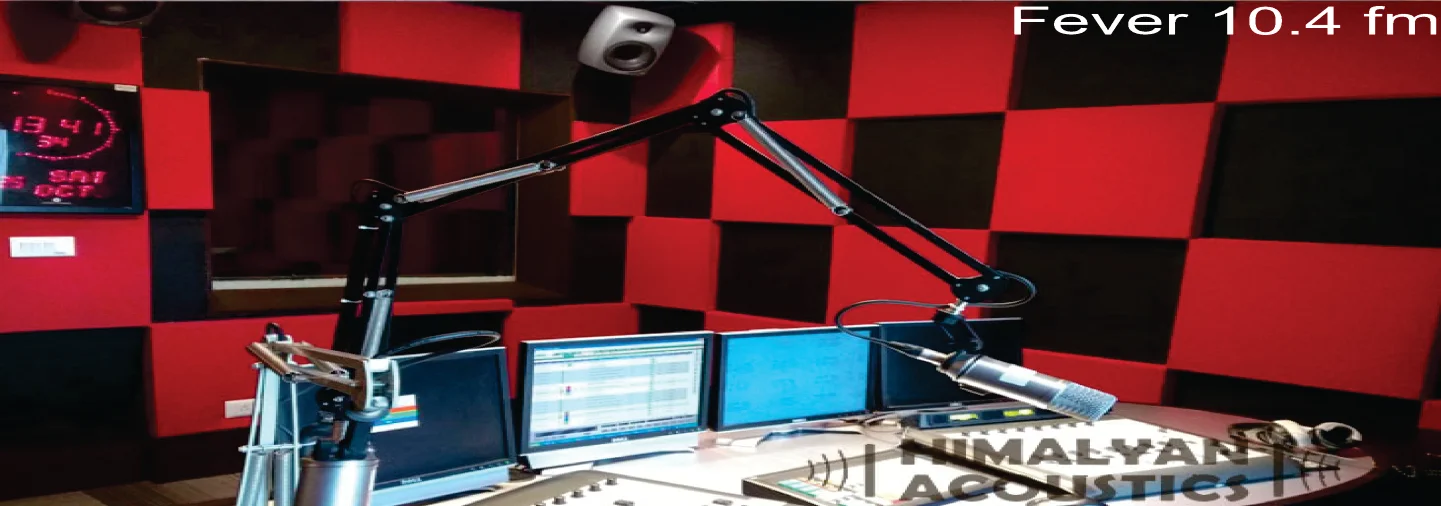
A professional studio needs more than quality microphones, speakers, and recording equipment. The room itself plays an important role in how sound is recorded, monitored, mixed, and experienced.
External traffic, HVAC systems, construction noise, neighbouring rooms, and sound leakage can interrupt recordings. At the same time, reflective walls, ceilings, floors, and untreated corners can create echo, flutter echo, bass build-up, and an uneven frequency response.
This is why effective soundproofing for studio projects should be planned alongside proper acoustic treatment. Soundproofing focuses primarily on reducing unwanted sound transmission between spaces, while acoustic treatment controls reflections, reverberation, and sound behaviour inside the room.
For recording studios, home studios, podcast rooms, voice-over spaces, and mixing rooms, the right combination of sound isolation and acoustic treatment can create a more controlled and predictable acoustic environment.
Himalyan Acoustics provides customized acoustic and soundproofing solutions based on room construction, intended use, noise sources, and acoustic requirements.
Soundproofing for a studio is the process of reducing unwanted sound transmission into or out of a recording or production space. It may involve appropriately designed walls, ceilings, floors, doors, windows, insulation, and vibration-isolation systems.
Acoustic treatment is different. It controls reflections, reverberation, and frequency behaviour inside the room. A professionally planned studio may require both sound isolation and acoustic treatment to achieve suitable recording and monitoring conditions.
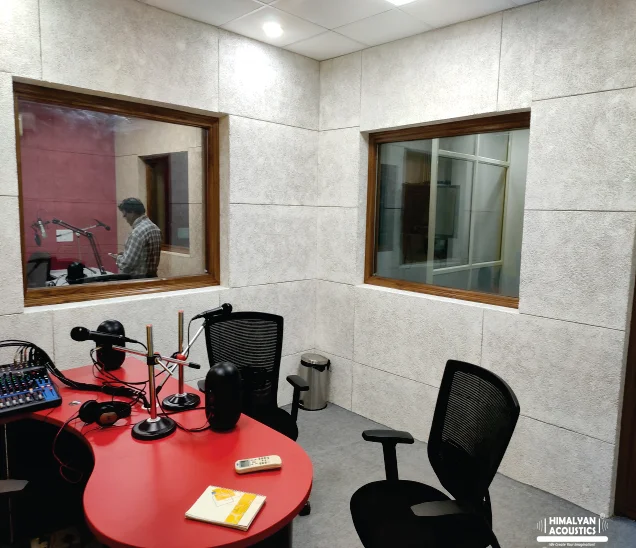
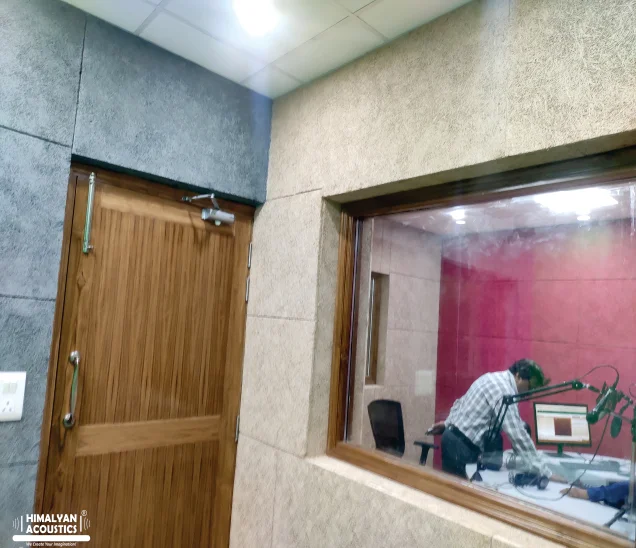
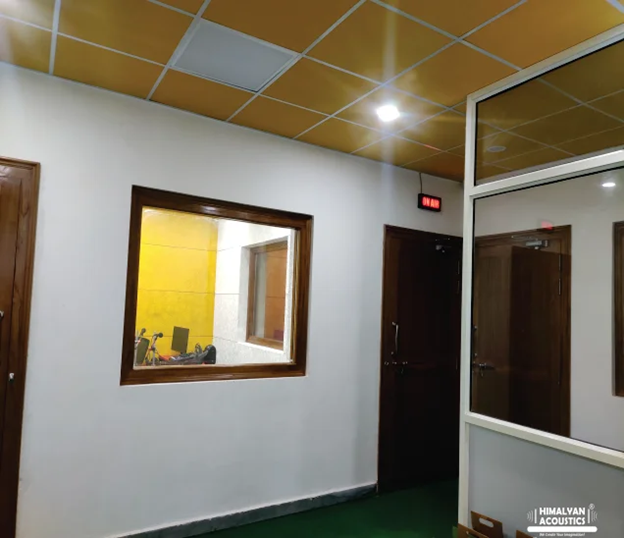
Studio soundproofing is primarily concerned with sound isolation. The objective is to reduce the amount of sound travelling between the studio and surrounding areas.
Sound can travel through several paths, including:
For example, a studio located beside a busy road may experience traffic noise entering through windows, walls, ventilation systems, or other weak points. Similarly, a music studio inside a residential or commercial building may need to prevent loud instruments or vocals from disturbing adjacent spaces.
Effective isolation therefore requires more than placing sound-absorbing panels on the walls. The complete building envelope and potential transmission paths need to be considered.
For related acoustic requirements, Himalyan Acoustics also provides acoustic insulation solutions for different applications.
Soundproofing and acoustic treatment are related, but they solve different problems.
| Factor | Soundproofing | Acoustic Treatment |
|---|---|---|
| Main purpose | Reduce sound transmission | Improve sound quality inside the room |
| Controls | External and internal noise transfer | Echo, reflections and reverberation |
| Typical solutions | Insulation, doors, partitions, isolation systems | Acoustic panels, bass traps, diffusers |
| Primary objective | Sound isolation | Controlled room response |
| Best application | Recording isolation | Recording and mixing accuracy |
A studio may therefore need both. A room can be well isolated from outside noise but still sound poor internally because of excessive reflections. Likewise, a room can have excellent acoustic panels but still allow traffic, HVAC, or neighbouring-room noise to enter.
Traffic, construction, air-conditioning equipment, generators, elevators, neighbouring rooms, and other environmental sources can interfere with recording.
Even moderate background noise can become noticeable during quiet vocal passages, acoustic instruments, voice-over work, or pauses between takes.
The first step is to identify the noise source and determine how it is entering the room before selecting an isolation strategy.
Sound LeakageSound can travel through walls, ceilings, floors, doors, windows, ducts, and small construction gaps.
A recording studio with strong wall construction can still experience poor isolation if the door is weak or improperly sealed. Similarly, untreated service openings can become significant transmission paths.
A professional soundproofing design therefore considers the complete room envelope rather than relying on one individual product.
Room Echo and Flutter EchoHard surfaces reflect sound energy back into the room. In an untreated studio, these reflections can make vocals, instruments, and speech sound less controlled.
Parallel walls can also create repeated reflections known as flutter echo. Appropriate absorption and, where suitable, diffusion can help control these reflections.
This is where studio acoustic treatment becomes particularly important.
Standing Waves and Bass Build-UpLow-frequency sound behaves differently from high-frequency sound. Room dimensions can create resonances or modes where certain bass frequencies become excessively strong in some locations and weak in others.
This can make a mix appear balanced at one listening position but inaccurate elsewhere.
Bass management should therefore be considered as part of the overall acoustic design.
Vocal ReflectionsVocals are particularly sensitive to unwanted early reflections. Reflective surfaces close to the microphone can influence the recorded sound and reduce clarity.
Strategically placed absorption can help control these reflections without making the entire room acoustically dead.
Poor Mixing AccuracyAn untreated room can affect the perceived frequency balance of a recording. A producer may compensate for excessive or missing frequencies because of the room rather than the actual recording.
A properly designed monitoring environment helps create a more predictable reference for mixing decisions.
Professional acoustic design should begin with the room rather than with a product catalogue.
Important considerations include:
The objective is not simply to cover every surface with acoustic material. Excessive absorption can create an unnaturally dry environment, while insufficient treatment can leave reflections and frequency problems uncontrolled.
A balanced studio typically requires a combination of sound isolation, absorption, bass management, and, where appropriate, diffusion.
Acoustic panels for studio applications are designed to absorb unwanted reflected sound and help control room reflections.
Their placement should depend on the room's acoustic requirements rather than simply covering available wall space. Panels may be positioned at important reflection points or other areas where absorption is required.
The appropriate panel type, thickness, quantity, and placement should be selected according to the room and its acoustic objectives.
Explore the available acoustic absorption solutions for controlling reflected sound in suitable spaces.
Bass TrapsBass traps are used to manage low-frequency energy, particularly in areas where bass can accumulate.
They can be important in control rooms and mixing environments where accurate low-frequency monitoring is required.
Acoustic DiffusersDiffusers redistribute reflected sound energy rather than simply absorbing it.
When used appropriately with absorption, they can help create a more balanced acoustic environment and prevent excessive deadening of the room.
Acoustic FoamAcoustic foam can have applications for controlling certain reflections, particularly at higher frequencies. However, it should not be considered a complete soundproofing solution.
Foam placed on walls cannot by itself prevent traffic noise from entering a studio or stop loud music from travelling through a structural wall.
Acoustic Ceiling TreatmentCeiling reflections can influence both recording and monitoring. Suspended acoustic systems or other ceiling treatments can help control reflected sound, particularly where the ceiling is highly reflective.
Soundproof Doors and Acoustic GlassDoors and windows can become weak points in an otherwise well-designed studio envelope.
Properly selected and sealed soundproof doors can help reduce sound transmission. Similarly, acoustic glazing can provide visibility between studio areas while supporting the required sound-isolation strategy.
Himalyan Acoustics also provides acoustic door and window solutions for projects where sound isolation is required.
Acoustic PartitionsAcoustic partitions can be used to divide studio areas while addressing sound transmission between spaces.
They can be particularly useful where multiple functional areas need to operate within a larger facility.
For room separation requirements, see the acoustic partition systems offered by Himalyan Acoustics.
Floating Floors and Vibration IsolationLow-frequency energy and structural vibration can travel through building elements. In appropriate projects, floating floors and vibration-isolation solutions can help reduce structure-borne transmission.
The requirement depends on the building construction, equipment, room use, and expected vibration sources.
Professional recording studio soundproofing requires consideration of the different functions within a studio.
Control RoomThe control room requires a controlled monitoring environment where reflections and low-frequency behaviour are carefully managed.
Recording RoomA recording room needs appropriate acoustic characteristics for the instruments or vocals being recorded. The desired acoustic environment can vary depending on the production requirements.
Vocal BoothA vocal booth requires controlled reflections while avoiding an excessively dead or unnatural sound.
Drum and Instrument RoomsDrums and amplified instruments can generate substantial sound energy, making both isolation and internal acoustic control important.
Isolation RoomsWhere multiple rooms operate simultaneously, isolation between spaces becomes particularly important.
Each area may therefore require a different combination of sound isolation and acoustic treatment.
See the Recording Studios project for an example of a studio environment treated for acoustic performance.
Effective studio acoustic treatment should create a controlled and predictable listening environment.
Important elements may include:
The goal is not necessarily to eliminate every reflection. Instead, the room should be controlled so that important reflections and frequency problems do not interfere with recording, monitoring, or mixing decisions.
A successful studio project starts with understanding the specific acoustic problem.
Himalyan Acoustics follows a customized approach that can include:
The appropriate solution depends on factors such as room construction, size, intended use, noise sources, sound transmission paths, and desired acoustic performance.
Depending on the project, solutions may include acoustic absorption, insulation, soundproof walls and ceilings, flooring systems, diffusion, vibration isolation, acoustic panels, doors, partitions, and other integrated acoustic systems.
This engineering-led approach helps ensure that the selected solution addresses the actual acoustic problem rather than relying on generic product placement.
Customized acoustic and soundproofing solutions can be useful for:
Each application has different acoustic requirements, so the treatment strategy should be designed according to how the space will be used.
For content-creation environments, you can also explore the podcast studio project from Himalyan Acoustics.
A properly designed acoustic environment can provide:
The actual results depend on the building, room design, materials, installation quality, and acoustic objectives. Professional assessment helps determine which improvements are actually required.
The cost of soundproofing for studio projects varies significantly because every building and studio has different requirements.
Factors that can influence the budget include:
For this reason, a fixed price based only on room size may not accurately represent the required solution.
A site assessment can help identify the primary noise sources, transmission paths, acoustic problems, and appropriate treatment strategy before the final scope and cost are determined.
Get customized acoustic treatment and soundproofing solutions designed around your project's requirements. Speak with our acoustic team to discuss your space and requirements.
Book an Acoustic Consultation


 +91 9779512233


