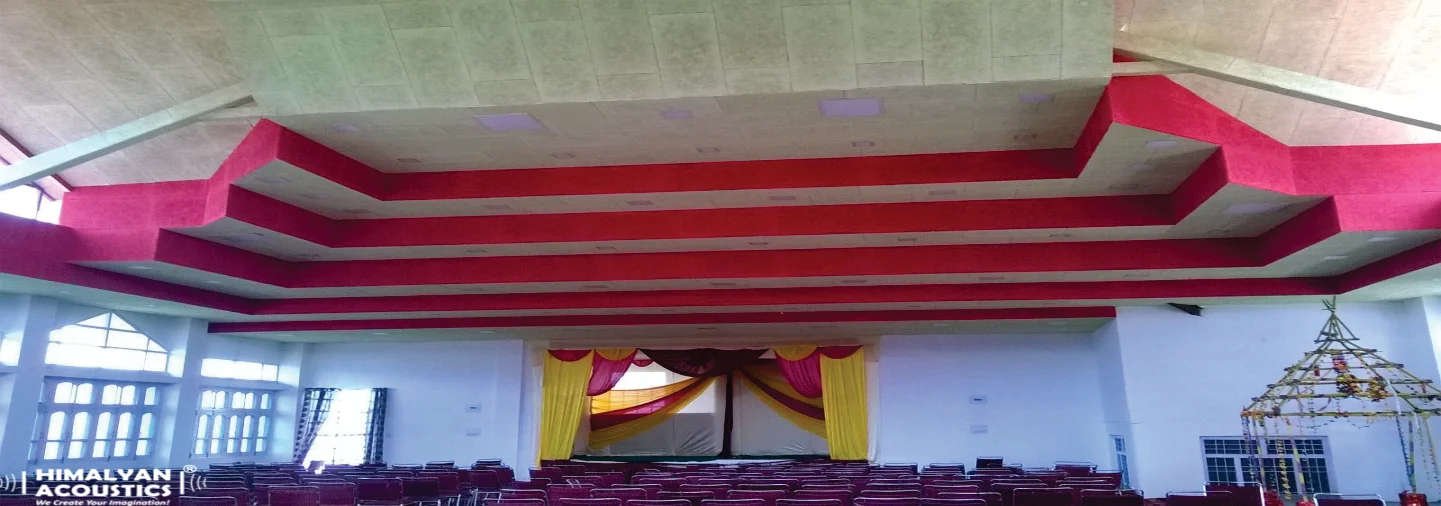
A temple hall can have a powerful sound system and still produce unclear announcements, muddy chanting, or uneven listening levels. People sitting close to the speakers may experience excessive loudness, while those farther away struggle to understand the same message.
The problem is often not a lack of amplifier power — it's usually the interaction between room acoustics, reflective surfaces, reverberation, speaker coverage, microphone placement and unwanted background noise.
In a large temple, marble or stone flooring, concrete walls, glass surfaces and hard ceilings reflect sound repeatedly. When these reflections arrive too close together or persist too long, speech intelligibility suffers — and simply adding more volume makes both the direct and reflected sound louder, not clearer.
This is why effective temple acoustics require a coordinated approach across three disciplines: acoustic treatment, sound insulation, and sound-system acoustic design.
Consider a large temple hall with:
Sound from a microphone or speaker doesn't reach a listener only once. Part of it arrives directly; the rest reflects off the floor, walls and ceiling before arriving at the same listener a fraction later. When the room has excessive reverberation, those reflections overlap with the speech that follows it.
The result can be:
The objective, therefore, isn't more sound — it's better-controlled sound.
Stone, marble, glass and concrete reflect a significant share of sound energy, and in a large hall those reflections can persist for a considerable time.
Reverberation isn't inherently a problem — some natural acoustic energy supports chanting, music and a sense of spaciousness. But excessive reverberation reduces speech intelligibility. The goal of acoustic treatment isn't to make a hall completely dead; it's to control problematic reflections while preserving the reverberant character appropriate for speech, chants and music.
A single sound source generates reflections from side walls, rear walls, ceiling, floor, columns and decorative surfaces. When these arrive at different times and from different directions, they interfere with how the listener perceives the original speech — which matters most in halls used for both spoken word and devotional music.
The most common response to poor coverage — "people at the back can't hear, so make it louder" — treats a distribution problem as a power problem.
If reflected sound is already excessive, raising the source level raises the reflected energy too. The listener gets more sound without getting clearer sound. A better approach examines room reverberation, speaker location and aiming, listening zones, acoustic absorption, reflection paths, background noise and microphone positioning — with the goal of consistent distribution, not maximum loudness.
These terms are often used interchangeably, but they solve different problems.
Manages internal reflections and reverberation through:
The correct treatment depends on the hall — hall dimensions, ceiling height, existing materials, seating arrangement, speaker locations, and the balance of speech vs. music requirements. More absorption everywhere is not automatically better.
This addresses sound travelling into or out of the hall, between adjacent rooms, or through doors, walls, ceilings, floors, gaps and mechanical systems. If traffic noise enters through windows, or the hall's sound disturbs a neighbouring residential area, an internal acoustic panel doesn't fix the transmission path — the fix has to target the actual path: sound-isolating wall assemblies, acoustic doors and sealed perimeters, acoustic glazing, wall and floor insulation systems, sealed penetrations, or HVAC and vibration control.
This is how the system delivers sound to the people actually in the room: speaker selection, positioning and aiming, distributed loudspeaker systems, listening-zone planning, level balancing, microphone placement, and how speakers interact with room surfaces. A large hall often benefits from distributed speakers rather than one powerful cluster at the front.
There's no universal package — a professional assessment identifies which of the following a specific hall actually needs.
Not every hall needs extensive isolation — the requirement depends on the actual noise path. A temple beside a busy road with noise entering through windows needs the building envelope addressed, not interior absorption. If sound is disturbing an adjacent office or residential space, the separating construction and transmission path need investigating.
The right question isn't "which soundproofing material should we install?" It's "through which path is the sound being transmitted, and what construction is required to control that path?"
Temple systems have a dual requirement: announcements, sermons and prayers need intelligibility, while chanting and devotional music benefit from natural acoustic energy. Speaker planning should treat the room as part of the system, not as a separate concern.
Situation: marble flooring, hard walls, a high ceiling — announcements sound blurred despite a powerful PA.
Likely cause: multiple reflections and excessive reverberation.
Approach: assess reflective surfaces and reverberation behaviour, then apply absorption, diffusion or ceiling treatment where it's actually needed.
Expected outcome: a more controlled environment where speech is easier to distinguish.
Situation: listeners near the speakers report excessive loudness while those farther away can't hear.
Likely cause: uneven coverage, not insufficient amplifier power.
Approach: review listening zones, speaker position and aiming, and system distribution; address excessive reflections where they're affecting clarity.
Expected outcome: more consistent sound across the intended listening area.
Situation: traffic, generators, fans or HVAC create background noise.
Likely cause: external or mechanical noise entering through building elements or equipment paths.
Approach: identify the transmission route, then apply the relevant wall, door, window, ceiling, floor or mechanical isolation.
Expected outcome: a better-controlled acoustic environment, subject to the actual construction and noise source.
Buying panels or speakers before understanding the problem tends to be ineffective spending. A professional project starts with the space — dimensions, volume, surface construction, reflective areas, reverberation, noise sources, speaker locations, listening zones, architectural constraints, HVAC/mechanical systems, and the balance of speech and music requirements.
Himalyan Acoustics' process is built around requirement understanding, site assessment and acoustic measurement, customised design, execution, and final testing and support — and its RT60 calculator to evaluate reverberation and compare treatment scenarios. This engineering-led approach separates the symptom from the actual acoustic cause.
This is more reliable than buying powerful speakers or installing panels without first understanding the hall.
Temple acoustics work as a system: room treatment affects reflections, isolation affects transmission, speaker design affects distribution, HVAC introduces background noise, and architecture determines the available surfaces and installation points. Changing one element changes the others — installing absorption changes the room's response and therefore how the sound system is perceived; moving speakers changes which surfaces receive direct sound. That's why coordination between acoustics, AV, architecture and HVAC matters.
Himalyan Acoustics positions its services around customised acoustic and soundproofing solutions, assessment, design and project execution, and specifically lists worship places among the industries it serves with a dedicated approach to worship acoustics.
The practical starting point should be the problem, not the product. A temple committee, architect, contractor or facility manager can discuss existing sound problems, hall dimensions, construction details, seating capacity, speaker arrangement, prayer and music requirements, external noise conditions, desired architectural appearance, and planned renovation or new construction — from there, the right combination of treatment, isolation and sound-system planning can be evaluated.
If a temple hall suffers from echo, unclear announcements, uneven distribution or unwanted external noise, turning the volume up won't fix the underlying cause. The first step is understanding what's actually causing it. Himalyan Acoustics can be considered for acoustic consultation, assessment, customised treatment, soundproofing and coordinated acoustic planning — and for wall or ceiling treatment specifically, its absorption and insulation solutions can be evaluated for the application.
Get customized acoustic treatment, sound isolation and sound-system planning designed around your temple hall's requirements. Speak with the acoustic team to discuss your space, sound problems and project goals.
Book an Acoustic Consultation


 +91 9779512233


